An overview of major themes I found while studying metafiction for the Metaclass, a self-study course for a masters of literature at San Francisco State University. This summary will also serve as a guide to the posts I have written over the last four months (with notes about a few others I intend to write). It is not meant to be a comprehensive list of meta conventions, but an addition to the the list found under Meta-Meta and Metafiction. (Nor is this intended to be a summary of themes I developed about writing and teaching, the metaclass aspect. Those themes may be found in Putting It All Together: Collaborative and Integrated Reading and Writing.)
Continue reading “The Conventions of Unconventionality: An Overview of Metafiction”
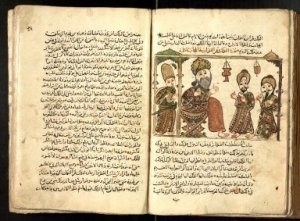 The Syrian manuscripts attempted to preserve and reproduce the “original” which stopped at two hundred and seventy-one nights but the Egyptian branch of manuscripts, Haddawy tells us in the introduction, “shows a proliferation that produced an abundance of poisonous fruits that proved almost fatal to the original” (Nights xv). Haddawy calls such additions “poisonous fruit” because he feels they destroyed its Arabic homogeneity. Besides deleting, modifying, adding, and borrowing from each other, “the copyist, driven to complete one thousand and one nights, kept adding folk tales, fables and anecdotes from Indian, Persian and Turkish, as well as indigenous sources, both from the oral and from the written traditions” (Nights xv). The tale of Sinbad is one such addition (the adventure is old, but its inclusion in The Arabian Nights is not). “The Story of Aladdin and the Magic Lamp” is actually a forgery written by a Frenchman named Galland and then translated into Arabic by a Syrian living in Paris to make it seem authentic, as evidenced by the French syntax and certain turns of phrase (Nights xvi).
 Freud expanded the concept of the pleasure principle, as he developed his theory of the death drive, into a broader, more inclusive life drive, which he associated with Eros, the Greek god of sexual love: “the libido of our sexual instincts would coincide with the Eros of the poets and philosophers which holds all living things together” (Freud, “Beyond” 619). Eros represents not only the sexual instincts, but thirst, hunger, self-preservation, reproduction, and creativity. Shahrazad, who holds all the living tales of the book together, is “intelligent, knowledgeable, wise and refined. She had read and learned” (Nights 15). This educated woman approaches her father, the vizier, and demands that he offer her to the killer king.
 The sexual instinct, which Freud said is so hard to “educate,” can be carried to such extremes that pleasure becomes destructive, even self-destructive. From the point of view of self-preservation, Freud writes, the pleasure principle is “from the very outset inefficient and even highly dangerous” (Freud, “Beyond” 597). The prologue, which establishes the frame story of King Shahrayar and Shahrazad, is dripping with destructive sexuality.